> For AI agents: the complete documentation index is available at https://docs.flashnerd.com/llms.txt, the full documentation bundle is available at https://docs.flashnerd.com/llms-full.txt.
# Templates and presets
A deck template defines the structure shared by its cards. A template preset is a reusable starting point for creating that structure.
| Change | What it affects |
| ------------------------------------- | ------------------------------------------- |
| Edit a card's field content | That card's value |
| Override a field's settings on a card | That card's presentation/settings |
| Edit a deck's template | Cards in that deck |
| Edit a custom template preset | The reusable preset used for future choices |
## Choose a preset for a new deck
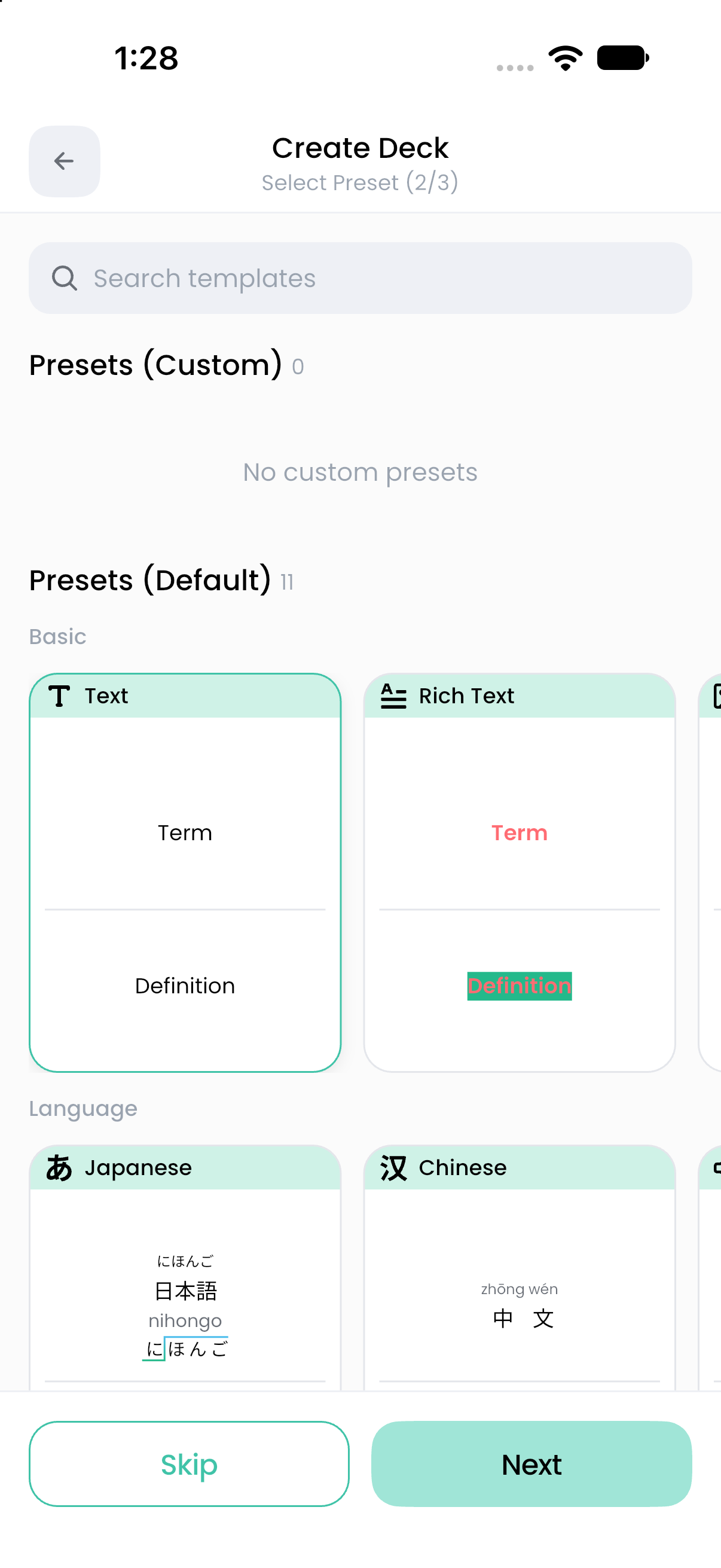
During **Create Deck**, **Select Preset (2/3)** presents **Presets (Default)** and **Presets (Custom)**. Default presets are grouped under **Basic**, **Language**, and **Specialized**.
The Text preset is a starting point for simple question-and-answer cards.
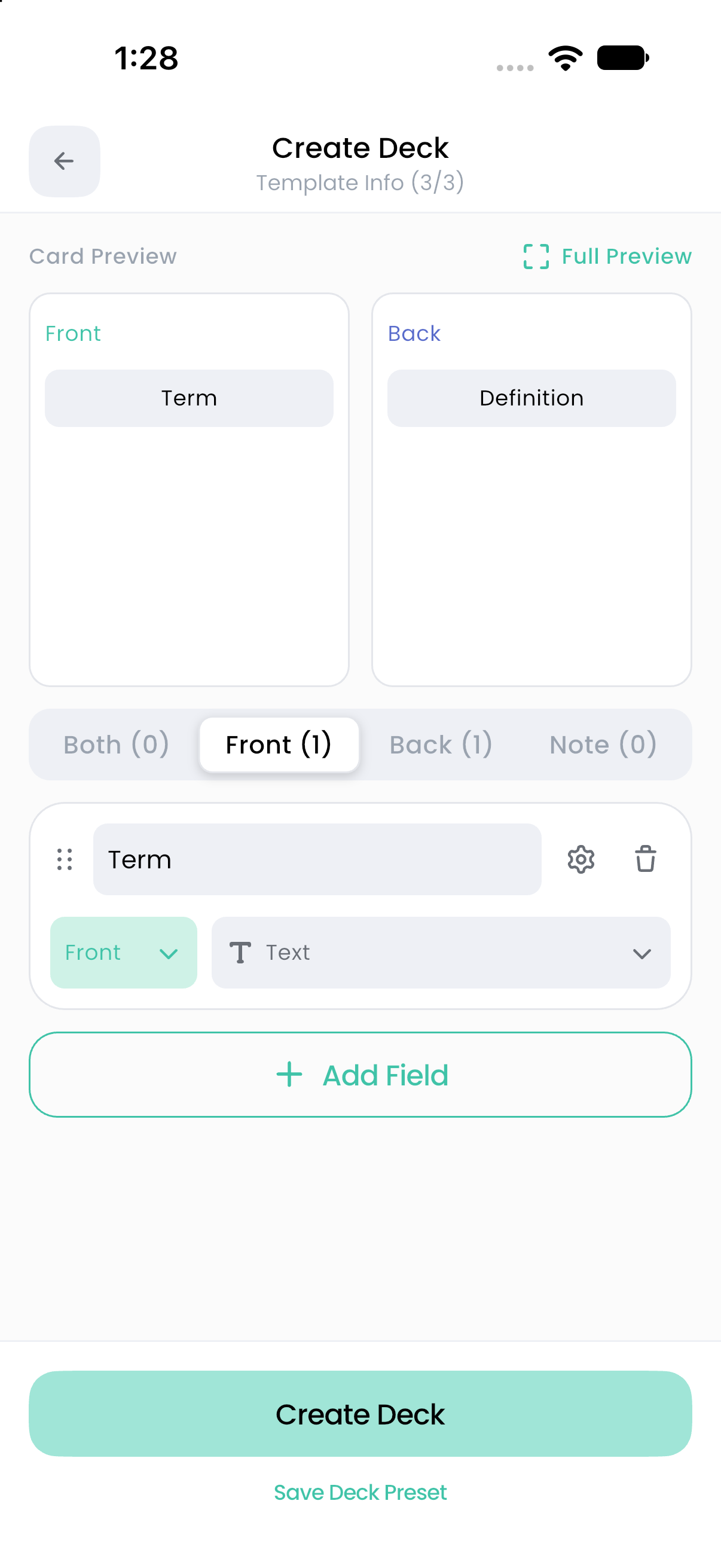
Choose one close to your intended content, then inspect **Template Info (3/3)**. You can change field names, types, placement, order, and settings before creating the deck. The new deck receives its own template rather than staying linked to a shared preset.
Check the field sides before creating the deck: Term asks the question, and Definition holds the answer.
## Change a deck's template
1. Open **Deck Detail**, tap the gear, then **Deck Template**.
2. Rename fields as needed. Names must be nonblank and unique within the template.
3. Use each field's side and type controls to choose **Card Side** and **Field Type**.
4. Use **Add Field** for another content field, the reorder controls to change field order, or the gear for detailed settings.
5. Inspect the template preview.
6. Save and confirm **Save template changes?**.
The template needs at least one field for the front and one for the back, and can contain up to **20 fields**. Both-side fields count toward the faces on which they appear.
:::warning Changes apply across the deck
Deleting a field deletes its values from every card in that deck. Changing a field's type can also erase values or formatting even when the save succeeds. Export a backup before restructuring a populated deck, and inspect representative cards afterward.
:::
### What a field-type change preserves
Text, Chinese, Japanese, TTS, Code, TeX, Cloze, and Rich Text can convert through plain text. Image and Image Occlusion can preserve their shared image. Other conversions cannot preserve the previous content.
| Change | Result for existing cards |
| ---------------------------------------------------------------- | ------------------------------------------------------------------------------- |
| Between text-compatible types | Keeps the text, but drops Rich Text formatting and Cloze markings when present. |
| Image → Image Occlusion | Keeps the image and starts with no masks. |
| Image Occlusion → Image | Keeps the image and removes the occlusion masks. |
| Between incompatible types, such as Text → Image or Audio → Text | Clears the old field values across the deck. |
Changing the type also resets that template field's settings to the new type's defaults. Malformed stored content can cause a conversion error and prevent saving; that error is different from the deliberate clearing performed by an incompatible conversion.
If only one card needs different display settings, use a [card-level override](https://docs.flashnerd.com/guide/cards/field-settings.md) instead.
## Save a reusable preset
While creating a deck, use **Save Deck Preset** on the Template Info step. Enter a unique **Deck Preset Name** and save it. This saves the structure as a custom preset; use **Create Deck** separately to finish making the deck.
You can also manage template presets through **Settings → Presets → Deck Presets**. Use the create control to create a preset, or open an existing custom preset to edit it and use **Save Preset**.
Default presets can be inspected but cannot be edited. Create a custom preset when you want a reusable variation.
## Delete a custom preset
Open the custom preset and use **Delete This Preset**. This removes it from the preset catalog. Decks previously created from it keep their own templates and cards.
Related: [Field type reference](https://docs.flashnerd.com/reference/fields/index.md), [Backups and exports](https://docs.flashnerd.com/guide/import-export/backups.md).